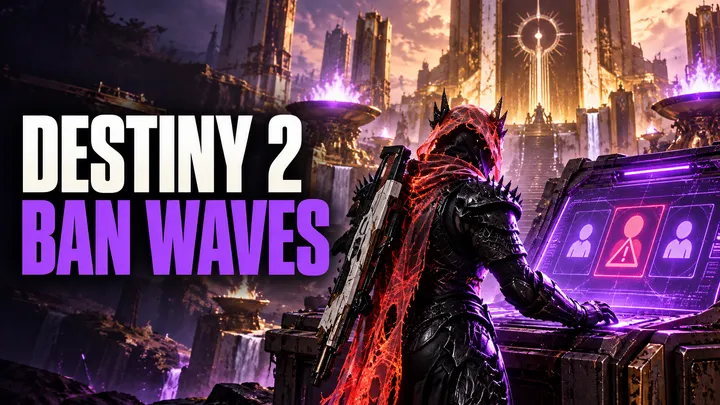
Destiny 2 cheat ban waves are batches of enforcement actions, and they do not always target the same behavior. Some involve cheating software; others include recovery services or players benefiting from a cheating fireteam.
That distinction matters before you trust a ban report or a seller’s protection claim. We reviewed Bungie’s explanations below to separate documented cases, detection mistakes, and practical prevention from guesses about how to stay undetected.
Table of contents
- What is a Destiny 2 cheat ban wave?
- Documented Destiny 2 ban waves and enforcement
- Why bans happen and what detection can establish
- Can Destiny 2 cheat bans be prevented?
- What undetected, streamproof and HWID claims mean
- What to do after a ban wave
- Our product and the limits of ban protection
- Key takeaways
- Frequently asked questions
What is a Destiny 2 cheat ban wave?
A ban wave means enforcement reaches a group of accounts together or within a short period. It describes the pattern of action, rather than one specific cheat or detection method.
Three dates can matter: when the conduct happened, when it was detected, and when Bungie announced enforcement. Those dates are not interchangeable.
For example, a statement published after a raid can describe cheating during that raid. Reading the publication date as the day every affected player cheated would give you the wrong timeline.
Likewise, a new security feature is not automatically evidence of a completed ban wave. A useful history separates actual account actions from announcements about future detection.
Documented Destiny 2 ban waves and enforcement
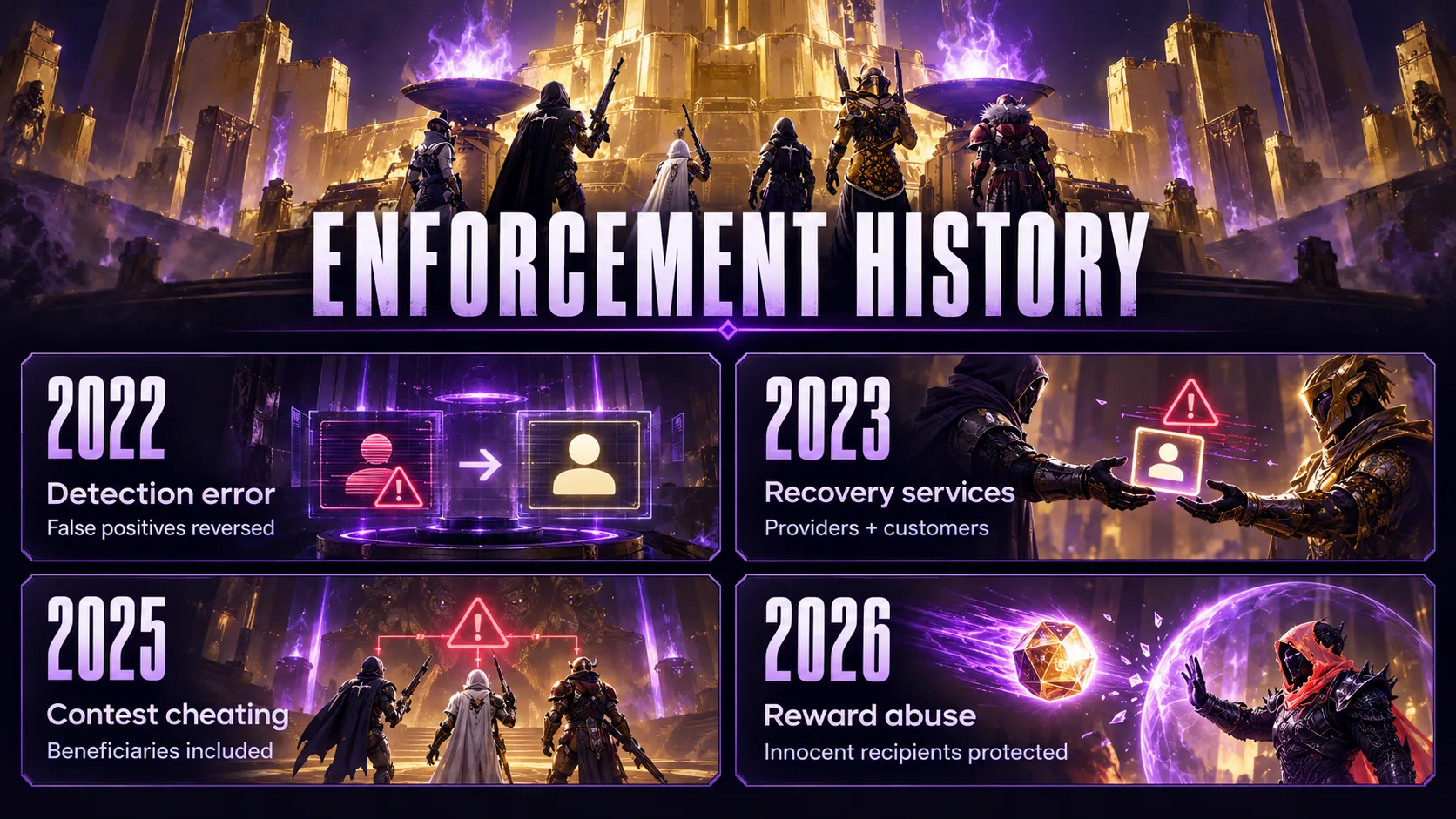
These four cases illustrate different reasons for enforcement. This is not a complete record of every Destiny 2 ban, and the dates identify the statements explaining each case.
| Statement date | Case | What distinguishes it |
|---|---|---|
| October 6, 2022 | Detection error within a wave | Bungie acknowledged false positives and reversals. |
| August 2023 | Account-recovery and boosting wave | Service users were among the targets. |
| August 7, 2025 | The Desert Perpetual Contest Mode wave | Enforcement included beneficiaries in cheating fireteams. |
| October 7, 2026 | Unearned reward and XP abuse | An enforcement update distinguished malicious users from innocent recipients. |
October 2022: a detection mistake affected legitimate accounts
In its October 2022 security explanation, Bungie attributed an error to a detection signature and identified approximately 60 false-positive accounts in that detection. It investigated and reversed affected actions.
That figure describes the identified mistake, not the total size of the wave.
The lesson is about evidence. An acknowledged error supports reviewing affected decisions; it does not establish that every disputed ban came from that error.
Treat individual claims of innocence and a developer-confirmed fault as different kinds of information.
August 2023: recovery and boosting services faced a large wave
Bungie’s August 2023 State of the Game described a major wave against recovery and boosting services and their customers. It also discussed expanded behavioral analysis and multiple factors in enforcement decisions.
This case challenges the assumption that only the person operating a cheat has something to lose. Handing over an account can separate the owner from the activity while leaving the account exposed to its consequences.
A seller’s description of a service is therefore an incomplete basis for judging risk. The relevant questions include who controls the account and what happens during that access.
August 2025: Contest Mode cheating affected whole fireteams
In its August 7, 2025 security update, Bungie confirmed a wave connected to The Desert Perpetual’s Contest Mode. It included players who benefited from cheating within their fireteams.
For prevention, the distinction is between participating in ordinary cooperative play and accepting a result produced through cheating. Personally avoiding cheat software does not answer every question about how a clear was obtained.
Do not turn this into a claim that every random encounter with a suspicious player produces a ban. The published case concerns cheating fireteams and beneficiaries, rather than a universal penalty for proximity.
October 2026: malicious reward spam and innocent recipients were separated
Update 9.7.0.5 addressed cheats that sent unearned rewards and XP to other players. Bungie distinguished malicious cheat users from innocent players who were not actively seeking the cheats or their benefits.
This is a documented enforcement update, not a published wave-size count.
It also explains why “someone received unusual rewards” is an incomplete accusation. Receiving something unexpectedly and arranging to obtain a cheat-assisted benefit are different situations.
Preserve that context when discussing a report or preparing an appeal.
Why bans happen and what detection can establish
A ban wave does not reveal a complete detection recipe. A developer can identify the conduct it acted against without publishing every signal, threshold, or investigation step.
The cases above describe different evidence problems: a faulty signature, service-related activity, cheating in a raid, and malicious reward abuse. Reducing all four to “the same cheat file was detected” would erase those differences.
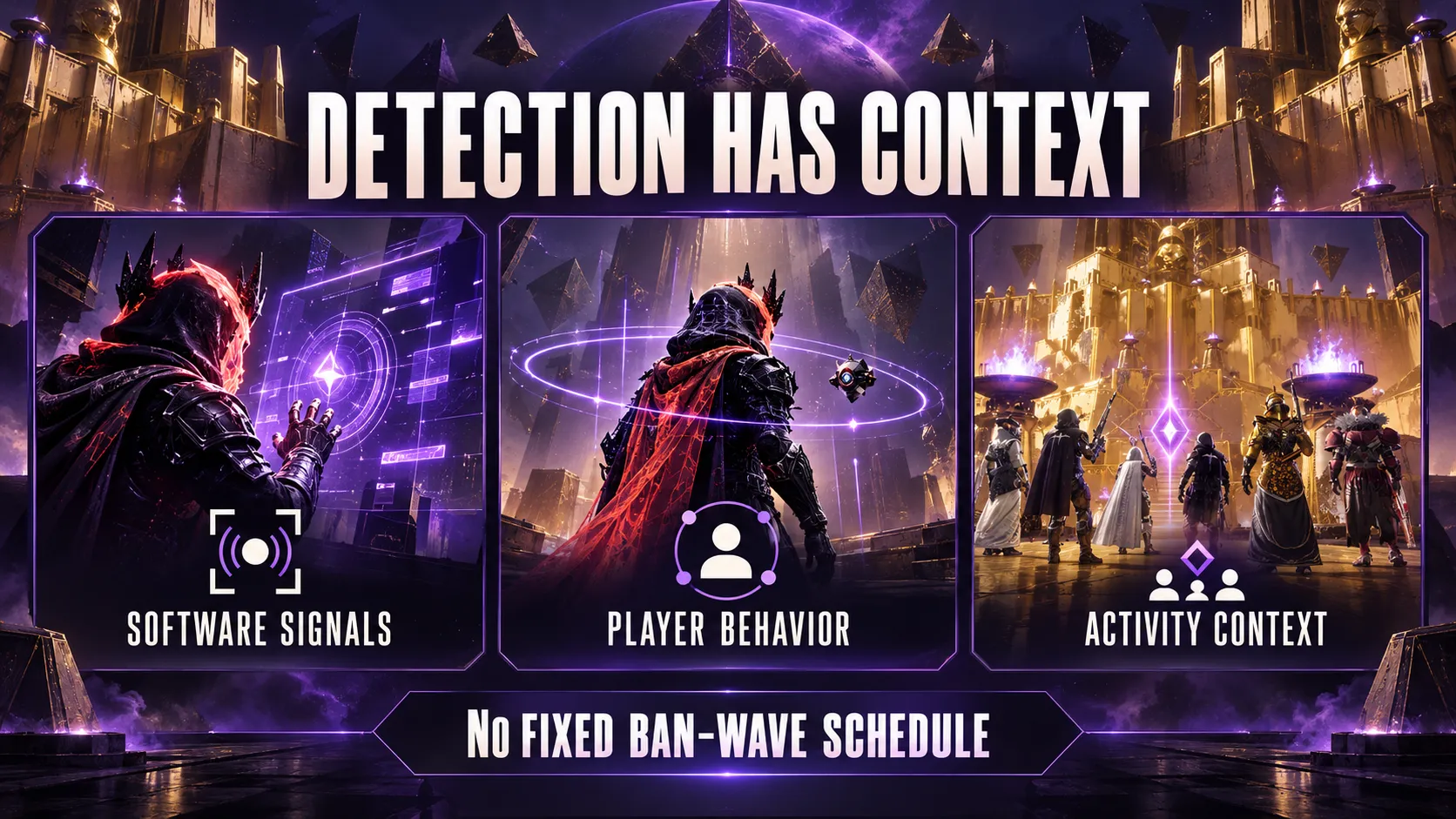
The 2023 security explanation also describes data science, machine learning, and work with BattlEye on network-manipulation tools. That supports a broader picture of enforcement than a simple search for one application name.
It does not disclose a test that players can use to certify an account as safe.
There is another distinction between evidence of conduct and the timing of punishment. An account remaining playable today does not establish that earlier activity was approved or went unnoticed.
Use that same standard when evaluating player reports. A screenshot can show an account message; it rarely establishes the complete cause.
A provider’s status announcement can describe its assessment; it does not reveal Bungie’s internal evidence.
Consequently, these examples cannot support a reliable countdown to the next wave, a safe play window, or a percentage chance that a particular account will survive.
Can Destiny 2 cheat bans be prevented?
The dependable way to avoid cheating-related violations is to avoid the prohibited conduct. There is no evidence in these cases that a particular aim setting, subscription, or play schedule guarantees protection.
Bungie’s account restrictions and banning policy distinguishes permanent bans from temporary restrictions and provides an appeal route. Prevention should begin with those rules.
A permanent ban has no scheduled expiry. A temporary restriction has a different duration and scope; the word “wave” does not tell you which penalty an account received.
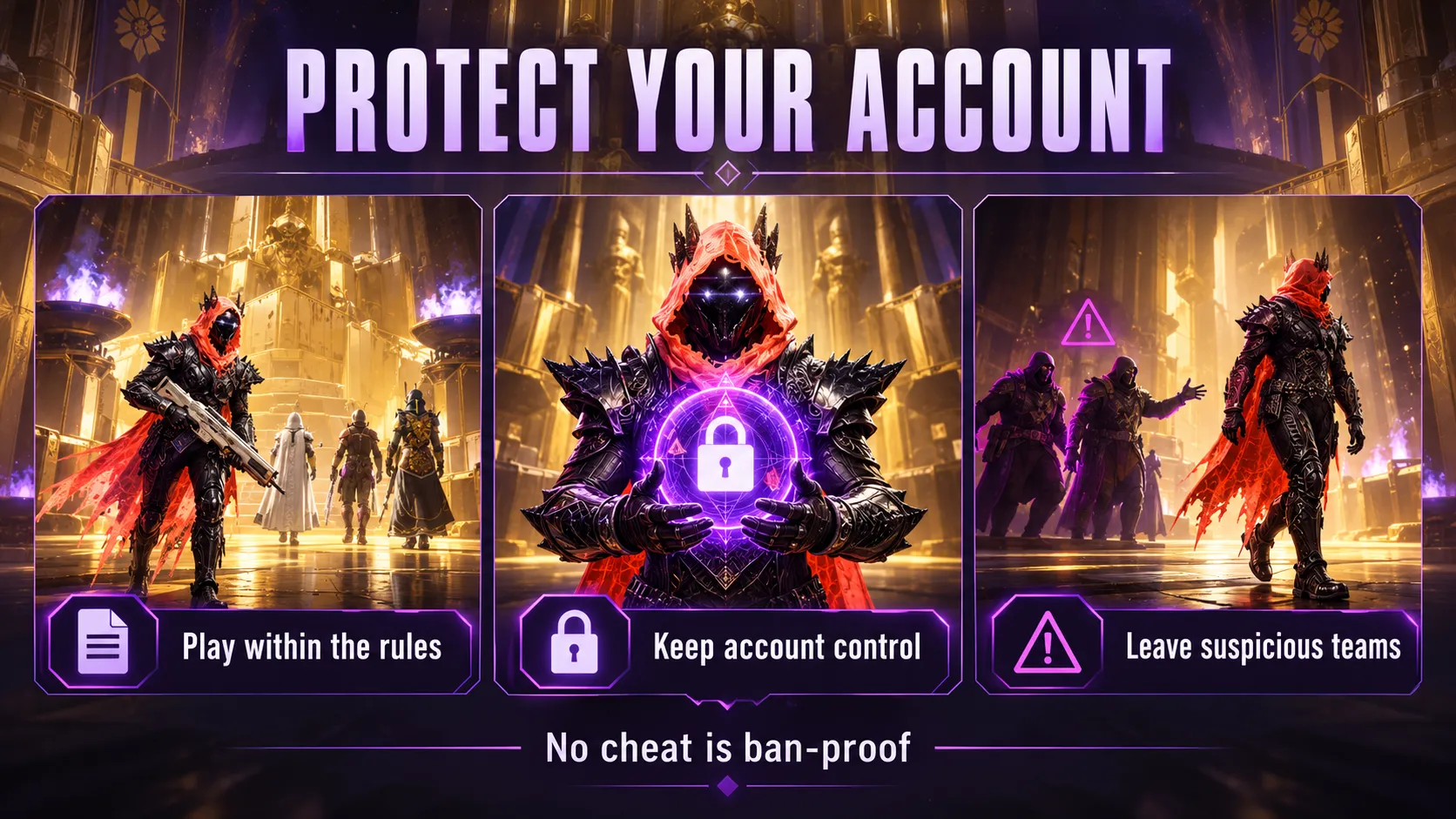
Keep control of your account
Do not make a service provider’s reassurance your only source of confidence. If someone else plays on your account, you cannot judge the session simply from the result they deliver.
Keep your credentials private, review account access, and secure the connected platform account. These are account-protection steps, not a promise to reverse enforcement for earlier conduct.
Leave suspicious fireteams instead of accepting the result
If a run appears to depend on cheating, stop participating. Do not assume that avoiding the software yourself resolves the concern while you continue collecting its benefits.
For an unexpected reward incident, record what happened rather than trying to reproduce it. The October 2026 case shows why whether someone sought the benefit matters to the explanation.
Separate real prevention from unsupported protection claims
| Proposed action | What it can address | What it cannot establish |
|---|---|---|
| Keep account access private | Exposure to another person’s activity | Immunity for your own conduct |
| Stop participating in a suspicious run | Further participation in that run | Erasure of earlier participation |
| Remove unauthorized software | Continued use on that installation | Clearance of earlier activity |
| Read a provider’s update notice | What the provider currently reports | Bungie’s internal detection status |
| Submit a factual appeal | A request to review an account action | A guaranteed reversal |
Prevention and damage control are different tasks. Stopping a behavior cannot prove that its earlier consequences have disappeared.
That is why advice to uninstall something and wait for a particular day should not be presented as a ban-prevention method.
What undetected, streamproof and HWID claims mean
Product terms answer different questions. Combining them into a single promise of safety makes the offer harder to evaluate.
| Term | What it usually describes | What it does not prove |
|---|---|---|
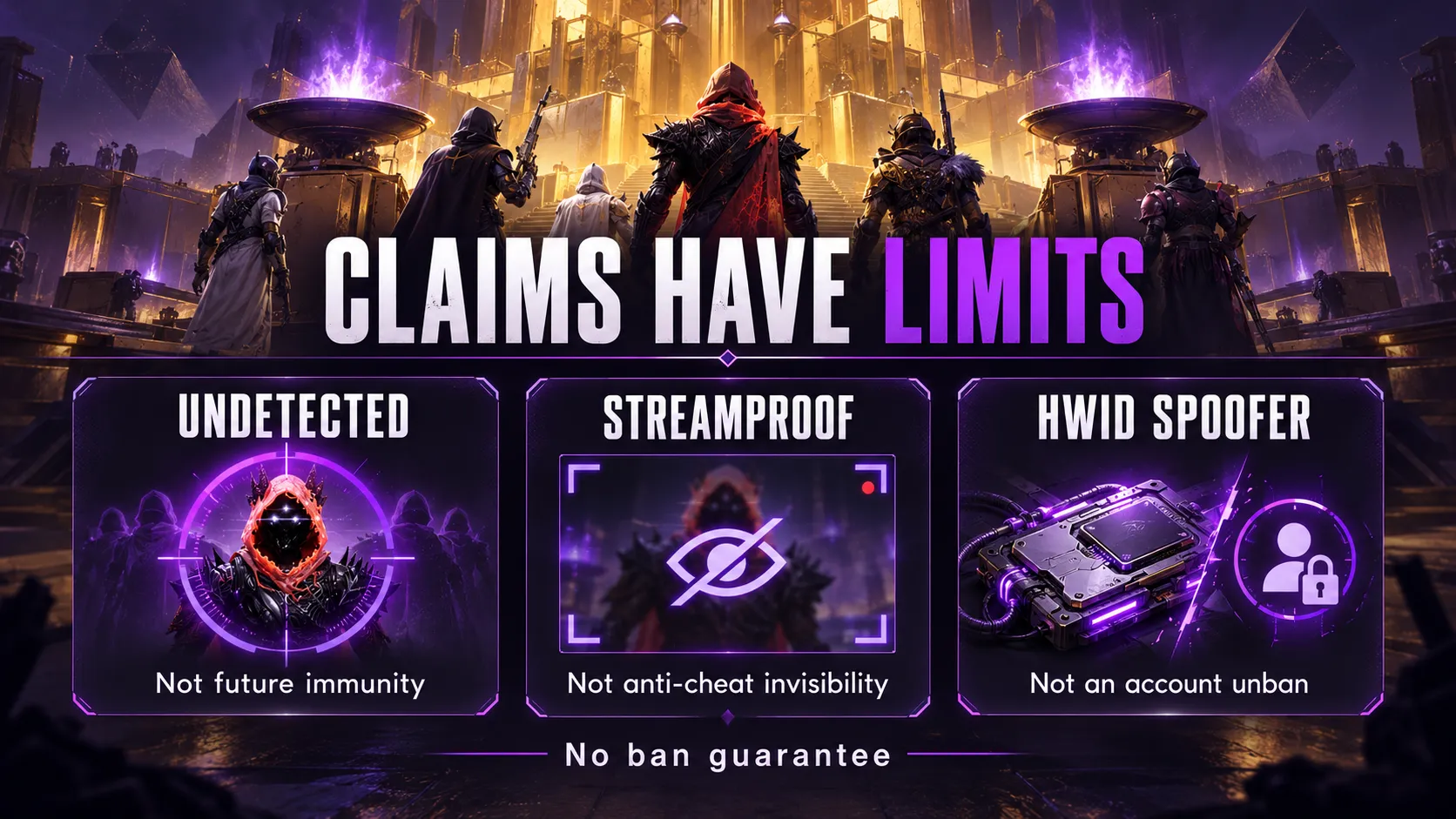
| Undetected | A provider’s present assessment of detection status | Future immunity or a cleared account |
| Streamproof | Whether an overlay appears in a particular capture setup | Invisibility to anti-cheat |
| HWID spoofer | Claimed changes to hardware identifiers | Reversal of an account ban |
| Regular updates | Ongoing maintenance | Proof that every detection is covered |
Treat each claim as a question requiring its own evidence. For example, a capture demonstration addresses what viewers see. It cannot establish what an anti-cheat system can observe.
The same separation applies to features. Our Destiny 2 aimbot page describes targeting controls, while our ESP and wallhack page describes visual information.
Feature descriptions are not detection-history evidence.
If you are comparing configurations, our Destiny 2 PC page supplies product-specific information. Compatibility, supported features, and enforcement risk still need separate answers.
What to do after a ban wave
Start with the message on your account. Record its wording and the affected activities instead of inferring the cause from a social-media headline.
Build a short, factual record:
- Save the notice. Keep the text and when you first saw it.
- Write the activity timeline. Include relevant sessions and anyone else who had account access.
- Preserve context. Note unexpected rewards or suspicious fireteam behavior without presenting guesses as facts.
- Use the official appeal route. The Bungie policy linked above directs players to it.
- Be accurate about your conduct. Do not copy a false-positive story simply because it sounds similar.
An appeal is a request for review. A credible submission should help someone understand what happened, rather than promise an explanation you cannot substantiate.
The 2022 reversals demonstrate that errors can be corrected. They do not establish that another account has the same error or will receive the same outcome.
Our product and the limits of ban protection
Our Destiny 2 cheat overview brings together the feature list, plans, updates, and support information. Those details help you compare what is offered; they should not be treated as proof that Bungie cannot take action.
We cannot honestly promise a ban-proof cheat or a guaranteed safe configuration. A trial can help assess an offer, but it cannot prove long-term detection safety.
If you want to review our offer, see the Destiny 2 free trial and its current terms. The same enforcement risks apply during trial access.
Key takeaways
- Check the case and date before treating a report as a new wave.
- Distinguish direct cheating, service use, beneficiaries, and innocent exposure.
- A detection mistake does not explain every disputed ban.
- Avoid prohibited conduct rather than relying on a claimed safe setting.
- Keep account access private and preserve facts for any appeal.
- Product labels do not establish immunity from enforcement.
Frequently asked questions
What is a Destiny 2 cheat ban wave?
It is a batch of account enforcement actions connected to detected violations. The announcement date does not necessarily identify when the violations happened.
When is the next Destiny 2 ban wave?
The cases covered here do not establish a predictable schedule. Treat claims about safe days or a guaranteed next-wave date as speculation.
Can I get banned for cheating only in PvE?
Yes. Bungie’s August 2025 Contest Mode wave specifically involved raid cheating and players who benefited from it.
Can a teammate’s cheats affect my account?
Yes. The Contest Mode case shows that consequences can extend beyond the person running the software.
Does receiving cheat-generated XP automatically mean a ban?
No. Bungie’s October 2026 update protected innocent recipients who were not actively seeking the cheats or their benefits.
Have Destiny 2 ban waves included mistakes?
Yes. Bungie acknowledged false positives in its October 2022 explanation and reversed affected actions.
Does undetected mean a cheat is ban-proof?
No. A present-tense detection claim cannot establish immunity from future detection or enforcement.
Can uninstalling a cheat guarantee that I avoid a ban?
No. Removing software does not prove that earlier activity went undetected or that an account has been cleared.
Does streamproof mean anti-cheat cannot detect a cheat?
No. Capture visibility and anti-cheat detection are separate questions. A hidden overlay is not evidence of ban protection.
Can our support team reverse a Bungie ban?
No. Product support cannot decide Bungie’s enforcement outcome. Use the official appeal route rather than relying on an unban promise.