Destiny 2 cheats work by altering what a player can see, how their inputs behave, or what the game appears to let them do. An aimbot targets Guardians or NPCs, ESP adds information to the screen, and other tools claim to change firing, ammunition, abilities or movement.
Those are different mechanisms with different limits. This guide explains the feature labels, how they fit together, and the enforcement risks Bungie describes.
Most features follow the same broad sequence: a tool obtains information about the game or what appears on screen, chooses a target or effect, then displays extra information or applies an input. The final step is to observe what Destiny 2 actually does. An overlay appearing locally does not prove that a shot registered, a movement change persisted, or the game granted a reward.
Table of Contents
- How the feature groups differ
- How aimbot and triggerbot work
- How ESP and wallhack work
- What weapon, ability and movement cheats claim to change
- Internal, external and device-based approaches
- What streamproof and HWID spoofer mean
- Detection and Destiny 2’s rules
- How to evaluate a feature claim
- Key takeaways
- Frequently asked questions
How the feature groups differ
The simplest way to understand a cheat menu is to ask which part of the game experience it claims to change. A feature name is a description of intent, not proof that the feature works in every activity or on every platform.
| Feature group | Claimed effect | What it does not establish |
|---|---|---|
| Aimbot and triggerbot | Moves aim toward a target or fires when conditions are met | That shots hit, damage registers or the tool is undetected |
| ESP and wallhack | Adds target information or reveals otherwise obscured entities | That every entity or location is available to the tool |
| Weapon and ability changes | Claims to alter recoil, spread, ammunition, fire rate or ability use | That the server accepts the claimed change |
| Movement changes | Claims to alter speed, flight, collision or position | That the game will preserve the change online |
| Spoofing and capture options | Claims to affect device identifiers or what a recording shows | That an account is protected from enforcement |
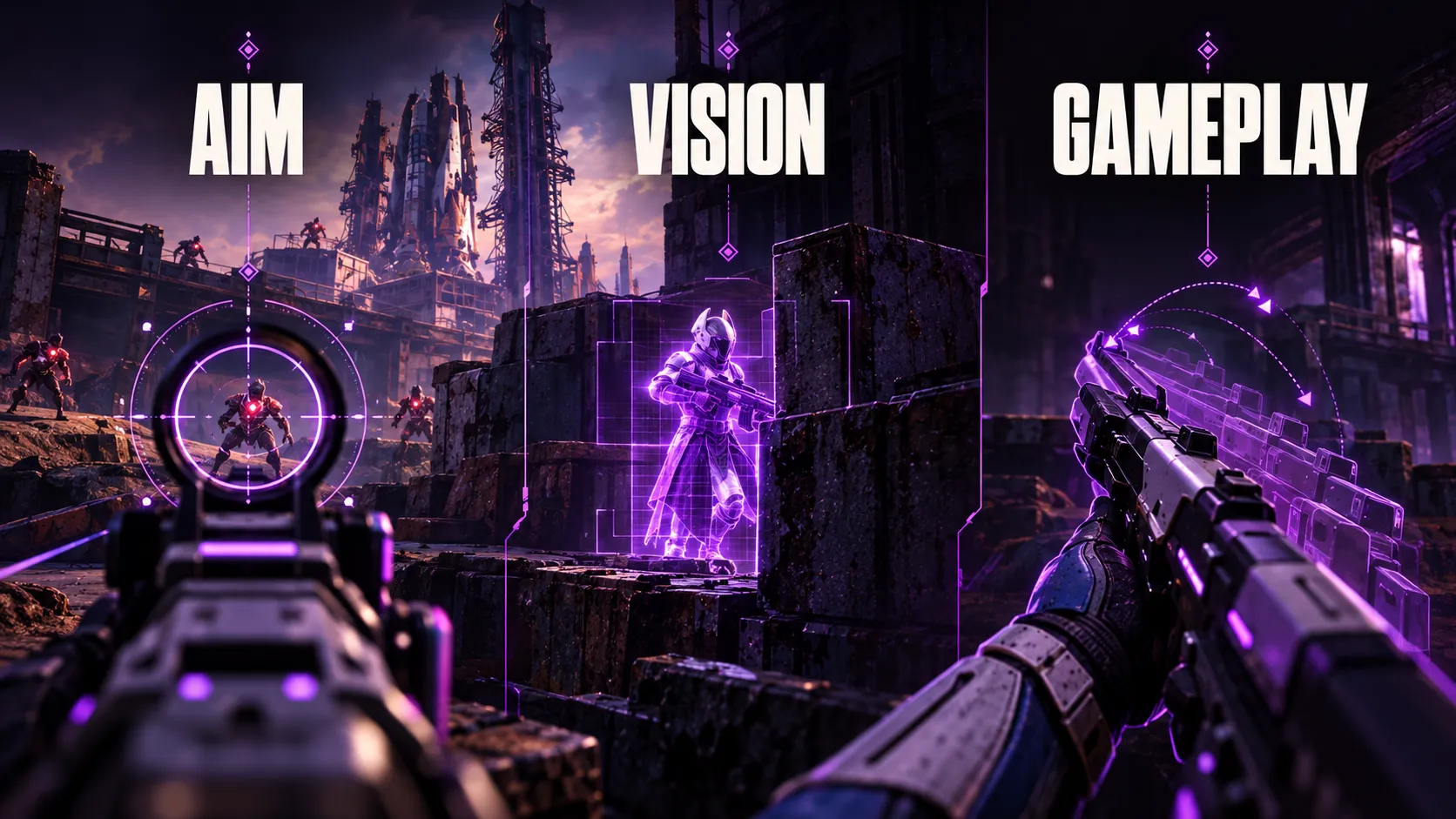
Our Destiny 2 PC feature list names examples in each group. The mechanisms below describe the labels at a conceptual level; they are not an independent test of every listed option.
How aimbot and triggerbot work
An aimbot identifies a possible target and applies aim correction toward a chosen point. In the menu, player targeting refers to Guardians and NPC targeting refers to AI combatants.
A selected field of view (FOV) limits the area around the crosshair where the tool looks for targets. That is a targeting setting, separate from changing the game’s camera FOV.
Target filters determine which candidates count. A team check, for example, is intended to exclude friendly Guardians; a head or bone selector chooses where the aim correction goes. Smoothing controls how quickly the crosshair moves toward the target.
Movement and bullet-drop prediction are advertised as adjustments for moving targets and applicable projectiles, though an individual shot still depends on the weapon and game state.
A triggerbot has a different job: it attempts to fire when its target condition is met. It does not necessarily move the crosshair. An aimbot can therefore influence where the player aims, while a triggerbot influences when a shot is taken. Neither term promises that a shot will register as a hit.
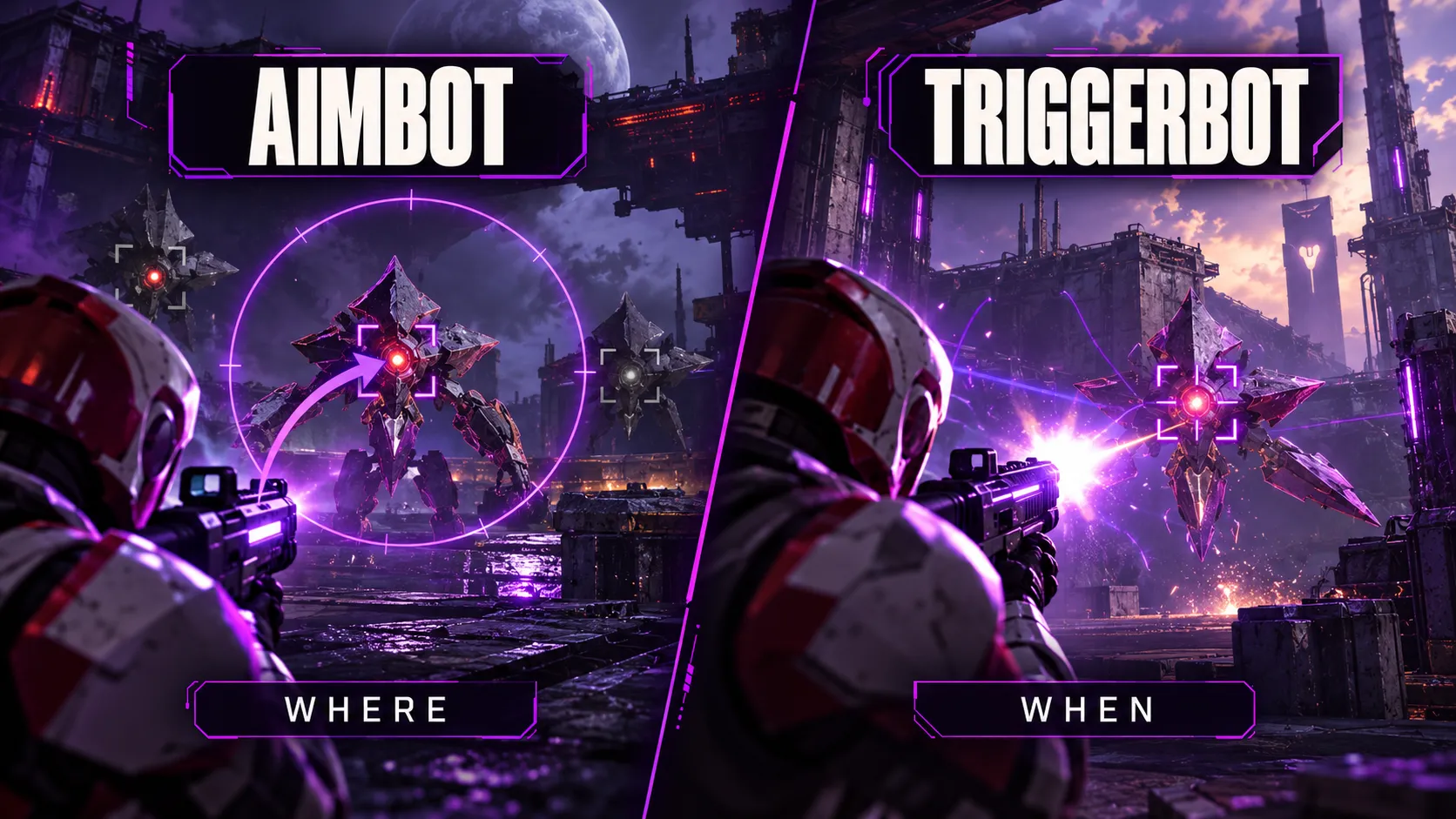
Our Destiny 2 aimbot feature page breaks out the current menu’s FOV, smoothing, target lock, prediction and player/NPC options.
How ESP and wallhack work
ESP is a visual information layer. It may mark a Guardian or NPC with a box, distance value, color or other indicator.
The goal is to show information the ordinary game view would not present in that form. Team and death checks filter the display so allies or defeated targets do not clutter it.
Wallhack describes the through-geometry visibility part of that experience. Some products use the words interchangeably, but the useful distinction is information overlay versus visibility through obstructing geometry.
Neither term means the game sends every hidden entity’s data to a client at all times. If the relevant information is unavailable, a visual tool cannot simply display it.
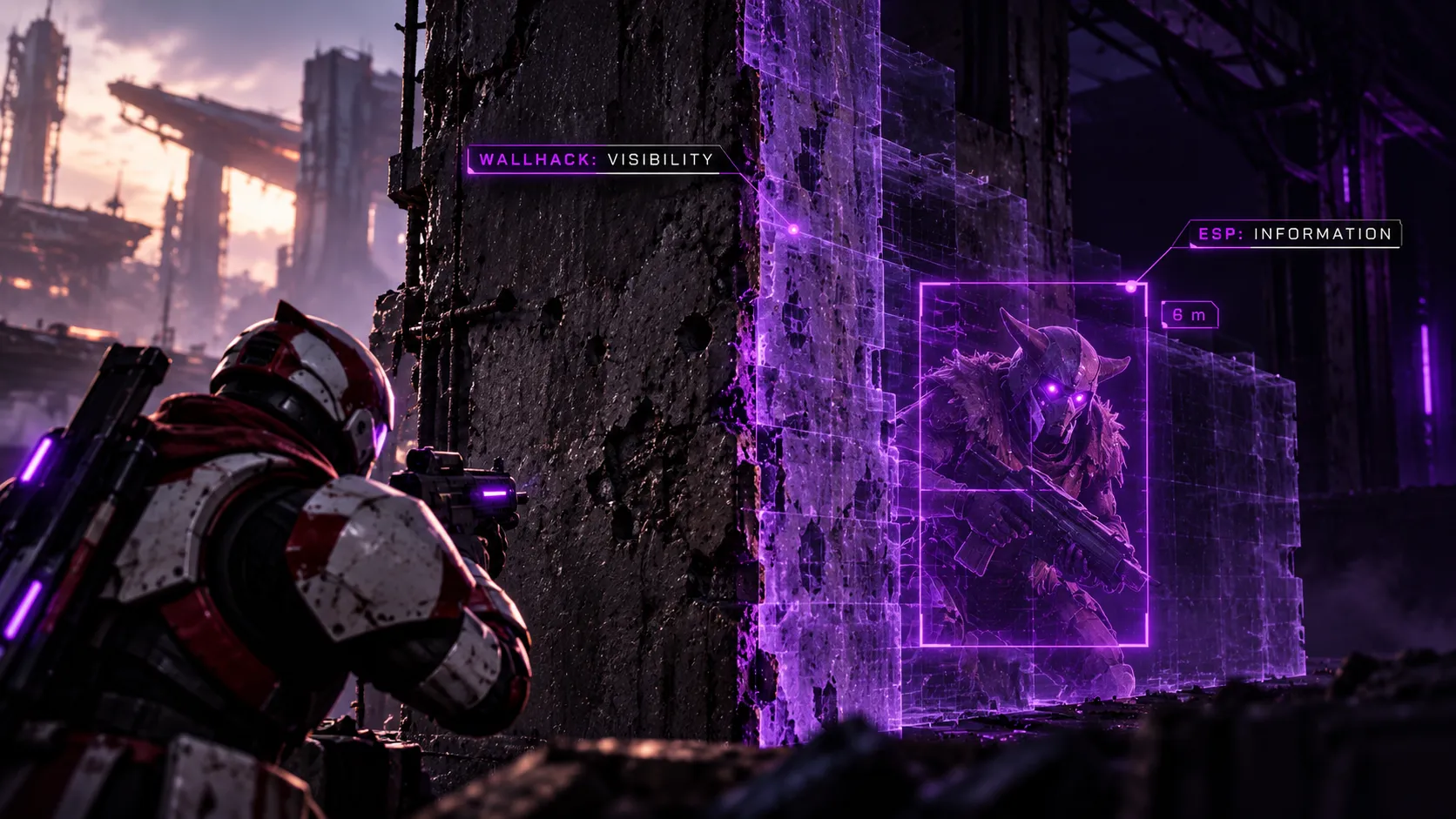
See our ESP and wallhack feature breakdown for the Player ESP, NPC ESP, distance, 2D box and filter options advertised in our build.
What weapon, ability and movement cheats claim to change
These labels describe effects beyond target selection or on-screen information. They need particular care because an on-screen change, a locally displayed value and a server-accepted gameplay result are different things.
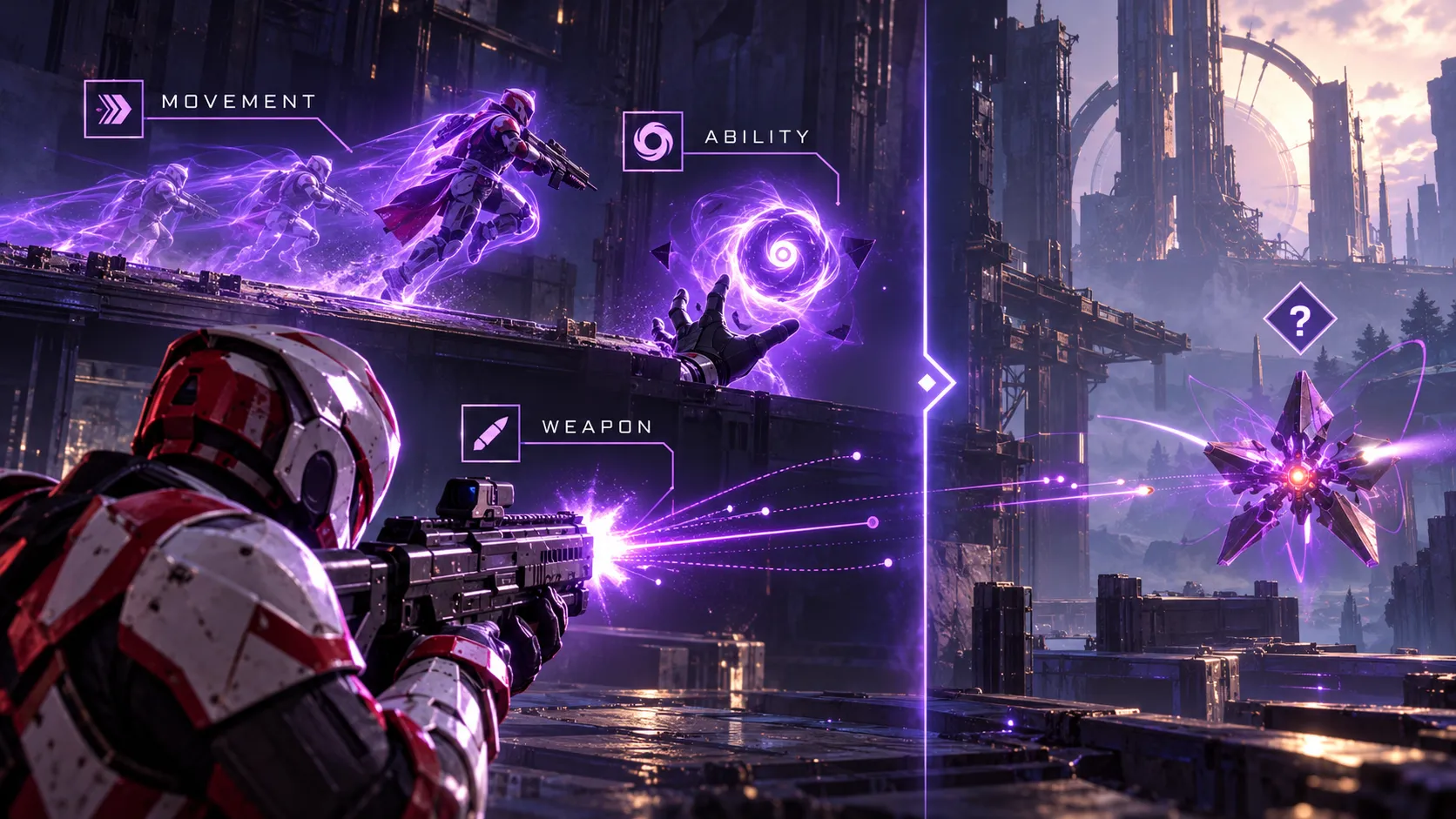
Weapon and ability options
No recoil claims to counter upward or sideways weapon movement. No spread claims to narrow shot dispersion; it is distinct from recoil. Unlimited ammo, fire-rate changes and skill-recharge changes claim to affect resource use or timing.
The precise outcome depends on what the game validates and where the relevant state is controlled. A menu toggle alone does not establish that every effect works in a live activity.
Movement and collision options
Speedhack and flyhack claim to alter how a character moves. No clip claims to let a character pass through geometry. Instant respawn is another advertised change to a game-controlled event.
These are especially broad labels: they do not tell you whether a result appears only locally, is accepted in a match, persists after correction, or works in a particular mode.
The distinction matters in PvE as much as PvP. A claim about clearing adds in a raid is not evidence that an encounter mechanic can be skipped or that a reward will be granted.
Our PS5 feature overview and Xbox feature overview list platform support claims; verify the exact setup and behavior for your device before treating a PC-oriented description as a console demonstration.
Internal, external and device-based approaches
These terms describe where a tool operates, not which feature it provides. An internal tool interacts from within the game process. Our internal vs external comparison goes deeper on the tradeoffs.
An external tool operates outside that process and may read available game state or produce a separate display or input. A device-based setup may affect inputs without presenting itself as a conventional game process plugin.
Products can combine approaches, and a feature list rarely proves an implementation method.
That distinction does not rank tools by safety.
Bungie’s PC application compatibility guidance says Destiny 2 resists attempts to insert code into its client, while its account policy also addresses external programs or devices used to modify, analyze or automate play.
Whether something runs outside the game process does not make it permitted.
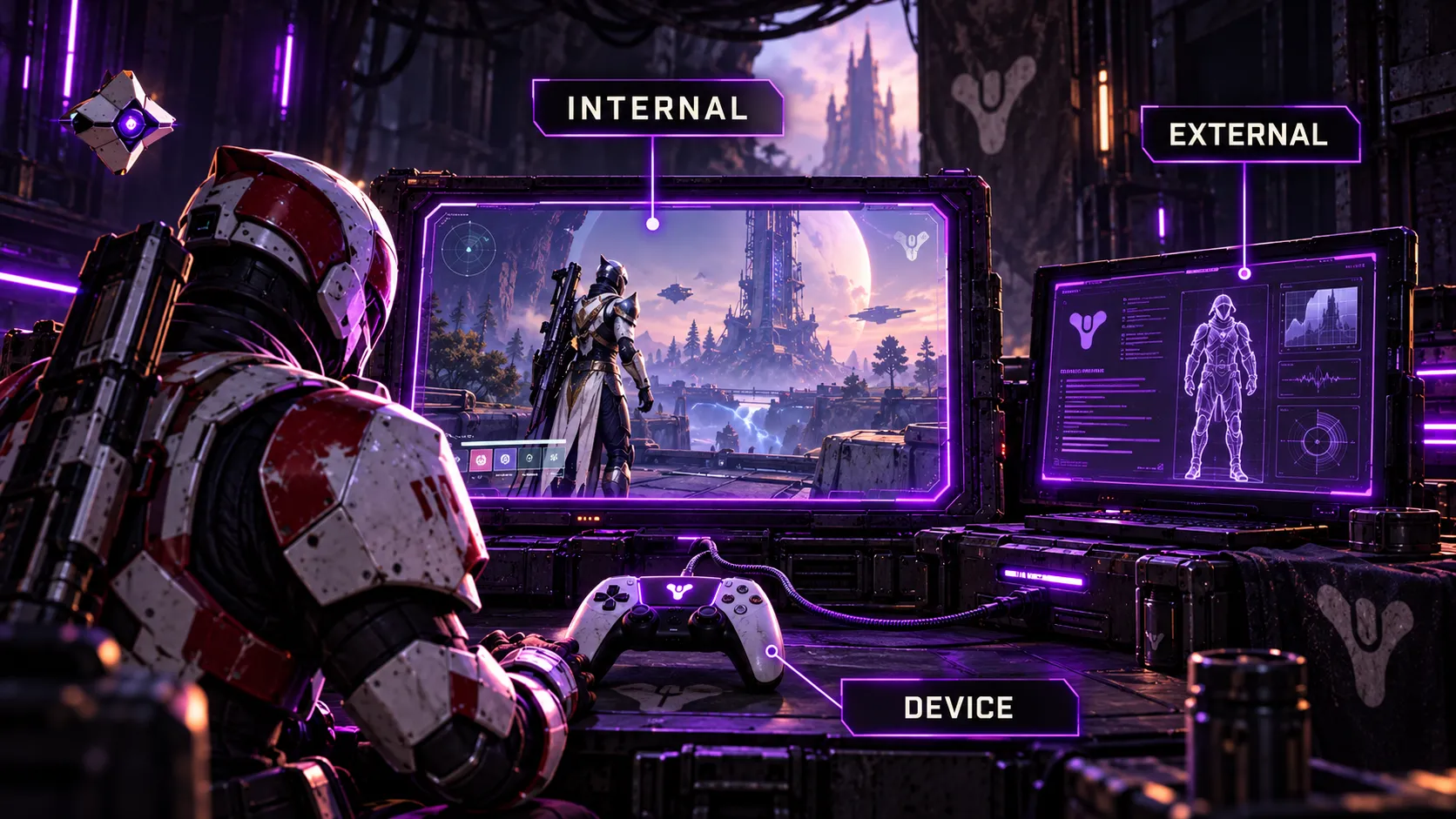
If you are comparing labels, ask what the tool claims to change and what evidence demonstrates that claim. “External” by itself does not answer whether it can draw an overlay, modify a game-controlled value, or avoid detection.
What streamproof and HWID spoofer mean
Streamproof usually describes a claim about capture: the tool’s overlay is intended to be excluded from some recordings or broadcasts. It says nothing by itself about whether the tool can be detected by Bungie or seen by another person watching the physical display. Capture behavior also depends on the recording setup.
An HWID spoofer claims to change or mask hardware identifiers presented to software. That is separate from the game features above and does not erase an account action.
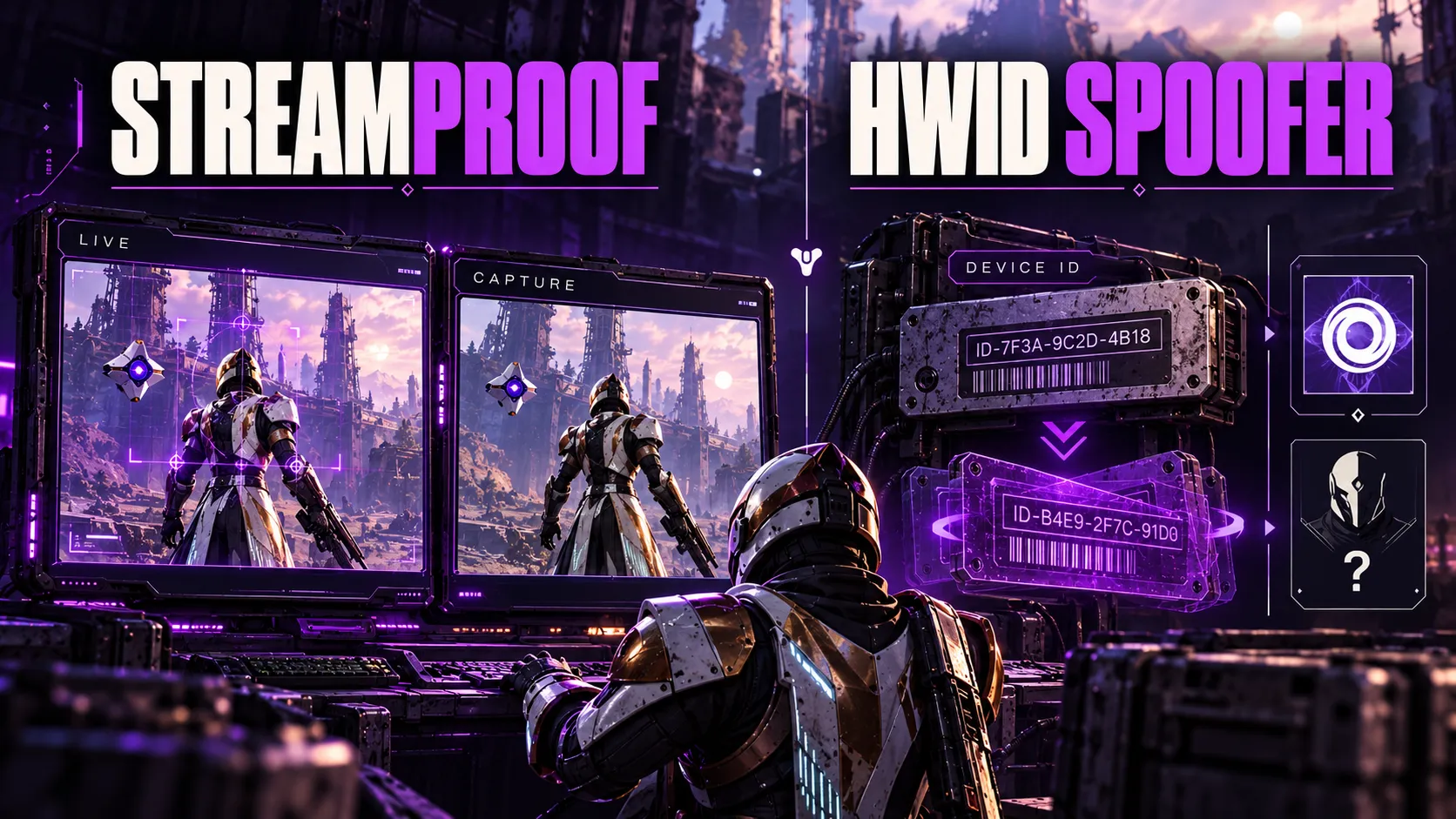
It also cannot justify a blanket promise against device-based enforcement. Treat “streamproof,” “spoofer” and “undetected” as distinct claims that require distinct evidence.
Detection and Destiny 2’s rules
Bungie’s BattlEye support guide identifies BattlEye as Destiny 2’s anti-cheat service and says it is active while the game runs.
Bungie’s Community Standards include cheating, code insertion and abuse of external accessibility tools among conduct that may result in restrictions or bans.
Bungie also names cheats, aimbots, autofire and automation in its account policy.
That policy is not limited to Crucible. Bungie says it evaluates gameplay violations across PvE as well, because benefits gained there can carry into PvP.
A product status such as “undetected” is a current seller claim, not a guarantee of future access or an exception to Bungie’s rules.
In Update 9.7.0.5, Bungie said it had changed backend code to address a reward and XP abuse case and was taking action against accounts that used the cheats maliciously.
Bungie also distinguishes ordinary applications from misuse. Its compatibility guide says common tools such as OBS and Discord are not grounds for a ban merely because they run alongside the game, while some overlay functions may be incompatible. The purpose and behavior of a tool matter more than the fact that it runs on a PC.
How to evaluate a feature claim
Read any menu or product page as a set of testable statements:
- Name the effect. Is it aim correction, information display, firing automation, a claimed game-state change or a capture option?
- Identify the activity. A Guardian duel, NPC encounter and raid mechanic present different targets and validation rules.
- Separate display from outcome. A box drawn on screen, a changed local number and a reward granted by the game are different observations.
- Check platform details. A claim of PC, PS5 and Xbox support does not explain installation method or demonstrate identical behavior on each device.
- Treat risk claims separately. Ask for current evidence of function and read Bungie’s policy before assuming a feature is acceptable or safe from enforcement.
If you want to inspect the feature list yourself, our Destiny 2 free trial page describes current access options. Availability and setup details can change, so check that page directly. A trial can help assess advertised features; it does not remove account risks.
Key takeaways
- Aimbot changes aim behavior; triggerbot concerns firing timing.
- ESP adds target information, while wallhack concerns visibility through geometry.
- Weapon, ability and movement labels describe claimed effects, not proof that a live server accepts them.
- Internal, external, streamproof and HWID spoofing refer to different aspects of a tool.
- Bungie’s rules cover cheating in PvE and PvP; “undetected” is not a guarantee.
Frequently asked questions
How do Destiny 2 cheats work in simple terms?
They attempt to add information, automate inputs or change gameplay behavior. ESP adds information, while an aimbot automates aim. Ammunition and movement changes claim broader effects. Whether an effect works in a live activity must be demonstrated separately.
Does an aimbot automatically fire?
Not necessarily. An aimbot concerns aim correction, while a triggerbot concerns firing when a condition is met. A menu may include both, but they are separate functions.
What is the difference between ESP and a wallhack?
ESP is a broad term for extra visual information, such as boxes and distance labels. Wallhack focuses on showing supported targets through walls or other geometry. Sellers sometimes group them together.
Can Destiny 2 cheats target NPCs as well as players?
Some advertised menus list separate player and NPC targeting or ESP. That describes the intended targets for PvP and PvE features. It does not establish that every enemy or encounter is supported.
Do cheats work the same on PC, PS5 and Xbox?
Do not assume so. A platform support claim does not specify the setup method or demonstrate identical behavior across devices. Check the current platform details and an actual demonstration for the setup in question.
Is an external cheat automatically safer than an internal one?
No. “External” describes where the tool runs, not whether Bungie permits it or can detect its effects. Bungie’s policy also covers external programs and devices used for cheating or automation.
Does streamproof mean undetectable?
No. Streamproof concerns what a recording or broadcast may capture. It does not establish anything about anti-cheat detection or account enforcement.
Does an HWID spoofer prevent bans?
No blanket guarantee follows from an HWID spoofer claim. Hardware identifiers and account enforcement are separate issues, and Bungie’s policy allows action against accounts and devices. A seller’s claim should not be treated as immunity.
Are PvE cheats allowed because they do not target other players?
No. Bungie says it evaluates gameplay for violations in PvE as well as PvP. Its policy covers cheating and automation that can grant loot or other advantages.
Is BattlEye active when Destiny 2 is running?
Yes. Bungie’s support guide says BattlEye is active on the player’s computer while Destiny 2 runs. That statement does not publish all of its detection methods.